
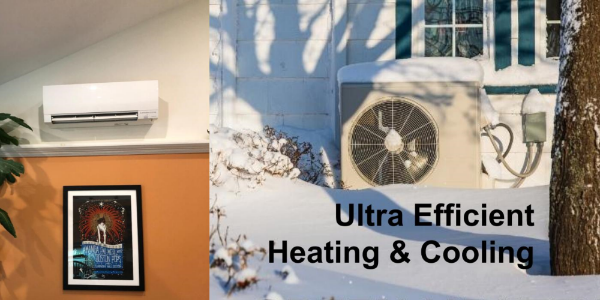
Heat and Cool with Mini-Split Heat Pumps

Category

Home Energy

Impact

Cost

?

Hot or cold, heat pumps have you covered!

Mini-split heat pumps are highly energy efficient and may be right for you if:

  1. You currently heat with electricity
  2. You are considering adding or replacing air conditioning
  3. You heat with oil
  4. You have one room that always stays cold and want to fix it

Heat pumps provide both cooling in the summer and heating in the winter. Mini-split heat pumps, in particular, do not require central ductwork and can create multiple zones in your home. For example:

  • Keep a nursery or guest room warmer than the rest of the house.
  • Add efficient cooling to bedrooms instead of relying on window AC units.
  • Avoid the hassle of installing and removing window units every year.

Incredibly, they only use half the electricity that would be used by window air conditioners for cooling. In winter, they deliver average efficiencies of 200–250%, compared to about 97% for oil boilers and 100% for electric baseboards1

Massachusetts Incentives & Savings

  • Mass Save Rebates: Many air-source and mini-split heat pumps qualify for rebates, often covering $500–$2,500 per unit
  • 0% HEAT Loan: Long-term, interest-free financing for qualifying upgrades. (Mass Save HEAT Loan)
  • Home Energy Assessments: Free assessment every three years; identifies eligible upgrades and incentives. 

Installing a heat pump in Massachusetts can dramatically reduce energy costs, improve comfort, and maximize available rebates and incentives — making it one of the smartest long-term home upgrades.

See the DEEP DIVE section to learn how mini-split heat pumps work and what to expect for installation costs.

Steps to Take

1. Get a free Home Energy Assessment
Heat pumps deliver the most benefit in well-insulated homes, so start with a no-cost assessment. In Massachusetts, the Mass Save Home Energy Assessment is offered free to homeowners, renters, and landlords. 

  • The assessment can be done virtually (phone or video) or in person, depending on your preference and local contractor availability.
  • You’re eligible for a no-cost assessment every three years.
  • During the visit, an energy specialist will identify leaks, insulation gaps, system inefficiencies, and guide you to rebates, incentives, or financing. 

2. Ask for a detailed, no-obligation estimate from a qualified installer
Once your home’s insulation and air sealing are addressed (or confirmed adequate), reach out to local heat pump installers for quotes. A good installer will size the system properly (taking into account your home envelope) and factor in equipment, labor, and incentives.

3. Review and apply for rebates, incentives, and financing

  • Many installers already help you access incentives, but it’s wise to be familiar with what’s available.
  • The Mass Save program often covers 75–100% of approved insulation upgrades and offers generous rebates on heating, cooling, and water heating equipment. 
  • Ask about 0% HEAT Loans — long-term, interest-free financing for qualifying upgrades. 
  • For renters and landlords owning 1–4 unit properties, Mass Save offers virtual or in-person assessments and may offer special incentives for upgrades. 

4. Move forward with upgrades and monitor performance
After installation, monitor your energy usage (e.g. with monitoring tools) and compare with pre-upgrade usage to track savings. Make adjustments or seek additional optimization as needed.

5. Share your experience
Let us know how it went by leaving a testimonial!

Deep Dive

Ok, but how do mini-split heat pumps work?

A heat pump doesn’t generate heat — it moves it. Much like a refrigerator pulls heat from inside the fridge and releases it into your kitchen, a heat pump transfers heat between your home and the outdoors.

In the winter, it extracts heat from outside air (even in very cold temperatures) and brings it indoors. In the summer, it works like an air conditioner by removing heat from inside your home and releasing it outside.

Mini-split heat pumps have two main components:

  • An outdoor condenser
  • One or more indoor air handlers, connected by a conduit through your wall

They are usually ductless, though some models use short-run ducts.

Want to see it in action? Watch the mini-split videos on Mass Save.

FAQ

Do heat pumps really work in New England?

Yes. Older models struggled in cold climates, but today’s cold-climate heat pumps are designed to perform efficiently in New England winters.

Are they expensive to run on electricity?

No. Because heat pumps move heat rather than generate it, they use much less energy than traditional systems.

  • Compared to electric resistance heaters, they save about 3,000 kWh/year (~$459).
  • Compared to oil systems, savings can reach 6,200 kWh/year (~$948).
  • When used alongside an oil system (for backup), annual savings average around $300.
    (Source: Northeast Energy Efficiency Partnerships)

Do I need to replace my whole heating system?

Not necessarily. Many homeowners layer heat pumps onto existing systems, letting the old system serve as backup during extreme cold. Heat pumps are compatible with:

  • Forced hot air
  • Radiators
  • Radiant floor heating
  • Or they can be fully ductless

Types of Air-Source Heat Pumps

  • Ductless: Minimal construction required, ideal for additions or rooms without ductwork
  • Ducted: Works with existing duct systems or in new construction
  • Short-run ducted: Limited ductwork for part of the home, often combined with ductless units
  • Split systems: One coil indoors, one outdoors, connected by ducts
  • Packaged systems: Both coils and fan are outdoors, connected through ductwork
  • Single-zone: One outdoor condenser paired with one indoor unit (perfect for a single room)
  • Multi-zone: Multiple indoor units connected to one outdoor condenser, allowing each space to be controlled independently

Which system is right for me?

A qualified installer is the best resource to size and design the right system for your home. For more details, check out this Mass Save heat pump buying guide.

Testimonials

🫠 No testimonials yet. Be the first to share your thoughts!

Add a Testimonial

0%

Subscribe

* indicates required
Email Preferences